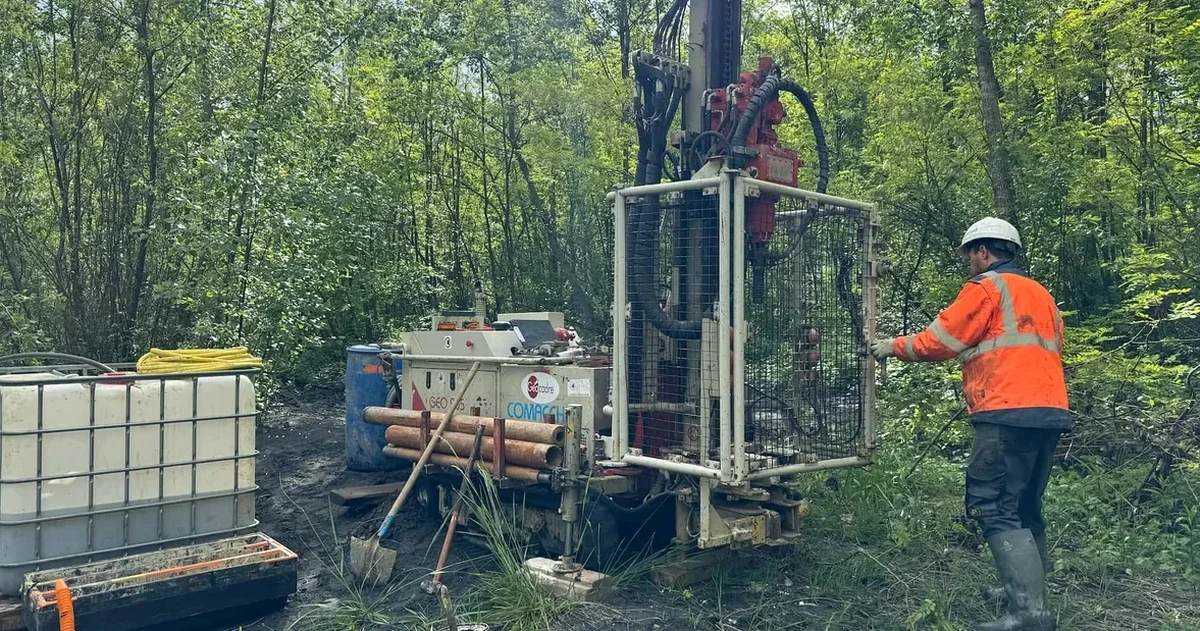
One of the most persistent errors we see in Leicester builds is treating the Mercia Mudstone across the whole site as uniform material, then wondering why differential settlement appears six months after handover. The drift geology here is far more complex than a single borehole log suggests — pockets of sand and gravel from the River Soar terraces, softened clay near buried channels, and occasional gypsum lenses create a subsurface mosaic that demands a full soil mechanics study. Foundation conditions can shift within 15 metres on a site near Abbey Park, and relying on generic bearing capacity tables without site-specific triaxial and oedometer data is how perfectly reasonable structural designs end up with cracking. We run the full suite under BS 5930:2015 and BS EN 1997-2:2007 to characterise strength, compressibility, and permeability before a single pile is driven.
Leicester's Mercia Mudstone can lose 30% of its undrained shear strength within 48 hours of stress relief — a timeline that site teams rarely anticipate.
Process and scope
When we work in Leicester, the first thing a local technician notices is the moisture profile in the upper 2.5 metres — the Mercia Mudstone weathers to a stiff, sometimes desiccated clay in summer, then swells markedly through winter, especially in the low-lying areas between the River Soar and the Grand Union Canal. This seasonal volume change is why we always pair a soil mechanics study with a
test pits investigation to log structure and take undisturbed block samples from the active zone. Consolidation testing then quantifies the coefficient of volume compressibility (mv) and the preconsolidation pressure, which tells us whether the clay has been unloaded by erosion and is now prone to heave or collapse. For sites on the alluvial gravels east of the M1, we combine shear box and ring shear testing on the finer fraction with a
CPT test to resolve thin silt lenses that boreholes often miss. The critical output is not just a pile load estimate — it is a parameter set for the whole stress path that the ground will actually undergo during excavation, dewatering, and long-term loading.
Area-specific notes
A 14-storey residential frame going up on a brownfield site off St. Margaret's Way ran into trouble not from the Mercia Mudstone itself, but from a 3-metre-thick lens of laminated silt that had been buried under 19th-century mill waste. The preliminary desk study missed it because the historical borehole logs from the 1970s terminated at 6 metres, just above the silt. When the piling rig reached that depth, the temporary casing lost toe resistance and groundwater from a perched aquifer flushed fines into the bore, delaying the programme by four weeks. A soil mechanics study with targeted sampling through the full drift sequence — using thin-walled Shelby tubes and in-situ piezocone dissipation tests — would have mapped that lens during the pre-tender stage. The remedial solution required base-grouted CFA piles socketed into the underlying mudstone, and the cost of the investigation would have been recovered ten times over by avoiding the downtime. In Leicester's post-industrial corridors, the legacy fill is never as homogeneous as the historical maps imply, and the geotechnical model has to be built on measured pore pressures and effective stress parameters, not on assumed stratigraphy.
Common questions
How long does a full soil mechanics study take from sampling to final report in Leicester?
For a typical mid-rise development with 6 to 8 boreholes, the laboratory programme runs 4 to 5 weeks from sample delivery. Consolidation tests require incremental loading stages that cannot be accelerated, and triaxial saturation and consolidation phases alone take 3 to 5 days per specimen. The factual report with all test data is issued within 2 weeks of completing the last test, and the interpretive geotechnical design report follows 1 week later. Sites requiring sulphate class confirmation can add 3 working days for chemical analysis.
Do you need soil mechanics testing if we already have SPT N-values from a standard investigation?
SPT N-values provide an index of relative density or consistency, but they cannot substitute for the effective stress parameters — c' and φ' — that govern long-term stability and settlement. A soil mechanics study measures the stress-strain response, pore pressure generation, and volume change characteristics directly, which is essential for any structure where serviceability limit states control the design. In Leicester's overconsolidated clays, the N-value alone can be misleading because a stiff, desiccated crust gives high blow counts while the underlying softened material yields much lower strengths under sustained load.
What is the cost range for a soil mechanics study in Leicester?
The laboratory testing programme typically falls between £2,580 and £3,710, depending on the number of specimens, the confining stress levels required, and whether chemical testing is included. This covers triaxial, oedometer, shear box, and classification tests on samples from a standard 4 to 6 borehole investigation. The cost varies based on the depth of the weathered zone and the need for specialist mineralogical analysis.
Which parts of Leicester are most affected by gypsum in the Mercia Mudstone?
Gypsum dissolution features are most frequently documented in the eastern and southeastern districts — around Evington, Oadby, and towards Wigston — where the Edwalton Member of the Mercia Mudstone Group contains persistent nodular and vein gypsum. The associated sulphate concentrations can exceed DS-5 thresholds under BRE Special Digest 1, requiring sulphate-resisting cement and additional protective measures for buried concrete. However, localised gypsum lenses can appear anywhere within the mudstone sequence, so we recommend water-soluble sulphate testing on every borehole sample, not just in the known high-risk corridors.
Can the soil mechanics study inform the choice between piled and raft foundations?
It is the primary decision-making tool. The consolidation test-derived OCR profile and the triaxial stiffness parameters allow calculation of immediate and consolidation settlement under the full building footprint, which determines whether a raft can satisfy the total and differential settlement criteria. If the weathered zone is thicker than 3 metres with mv values above 0.15 m²/MN, piles socketed into the unweathered mudstone often become the more economical solution once long-term serviceability is factored in. The study also provides the undrained shear strength profile needed to design the pile socket length and base resistance.