The soils beneath Leicester shift dramatically within a few miles, and this contrast shapes every foundation decision we make. The alluvial clays and silts along the River Soar floodplain behave nothing like the glacial tills and sands that cap the higher ground toward Oadby and Evington. When a borehole log shows a silty CLAY in the city centre but a sandy gravel out near Beaumont Leys, the particle size distribution becomes the first quantitative check that confirms—or challenges—the field description. A full grain size analysis, combining mechanical sieving for the coarse fraction and a hydrometer sedimentation test for fines passing the 63 μm sieve, gives the grading curve that feeds directly into soil classification under BS 5930 and the ground model required by Eurocode 7. We run these tests routinely in our Leicester laboratory, often paired with Atterberg limits to pin down the plasticity characteristics of the fine-grained portion when the hydrometer data shows more than 35 percent silt and clay.
A single hydrometer curve plotted alongside the sieve data often distinguishes a well-graded glacial till from a uniform windblown silt, and that distinction changes the drainage and settlement parameters for the entire project.
Process and scope
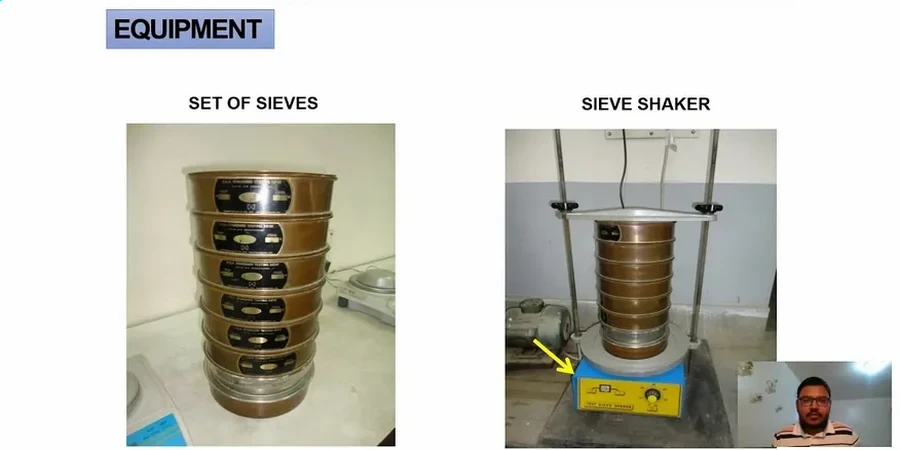
In Leicester, one practical detail that repeatedly surfaces during laboratory processing is the behaviour of the Mercia Mudstone-derived clays once they are oven-dried. These materials, widespread across the city, can develop hard, cemented lumps that skew the dry-sieving results unless the sample is carefully disaggregated with a rubber pestle before the nest of sieves goes onto the shaker. Our standard procedure follows BS 1377-2 for the sieve analysis: 200 mm diameter sieves from 63 mm down to 63 μm, weighed on a calibrated balance reading to 0.1 g, with the mass retained on each sieve expressed as a percentage of the total dry mass. For the fines below 63 μm, the hydrometer test runs over a 24-hour sedimentation period using a 152H hydrometer in a controlled-temperature bath, with readings taken at 0.5, 1, 2, 4, 8, 15, 30 minutes and then at 1, 2, 4, and 24 hours, applying meniscus and temperature corrections per BS 1377-2. The combined grading curve—sieve data plus hydrometer data—often reveals a gap-graded profile in the made ground that underlies much of Leicester's Victorian-era industrial corridors, a signature of ash and clinker fill that standard penetration testing alone cannot identify.
Area-specific notes
Leicester sits at roughly 60 metres above Ordnance Datum across much of the city centre, but the real geotechnical risk lies not in the elevation but in the 8 to 12 metres of superficial deposits—alluvium, river terrace gravels, and glaciolacustrine clays—that blanket the bedrock. When a grain size analysis shows a soil with more than 40 percent fines and a plasticity index above 15, the risk of excessive settlement under load becomes a design concern that foundation engineers cannot ignore. The hydrometer curve reveals the clay fraction percentage, and once that figure climbs above 10 percent, the soil may exhibit shrink-swell behaviour during Leicester's wet winters and dry summers, a seasonal cycle that has damaged lightly founded structures across the region. Missing the silt content is equally dangerous: uniform silts with D10 values below 0.02 mm are notoriously difficult to compact and susceptible to frost heave, a failure mechanism documented in several East Midlands highway projects where subgrade specifications were written without adequate particle size data.
Common questions
What sample mass do you need for a full grain size analysis in Leicester?
For a combined sieve and hydrometer test we typically require around 500 g of dry soil. If the material is predominantly granular, 1 kg is preferable to ensure adequate mass retained on the coarse sieves. Samples can be delivered to our Leicester facility in sealed plastic bags; we handle oven-drying and sample preparation in-house.
How does BS 1377-2 differ from the ISO standard for particle size distribution?
BS 1377-2 and BS EN ISO 17892-4 are closely aligned in methodology, but BS 1377-2 retains some UK-specific procedural details that are still referenced in many Network Rail and National Highways specifications. Our laboratory reports can be issued against either standard depending on the contract requirements, and the resulting grading curves are practically identical.
What does a combined sieve and hydrometer test cost?
The typical cost for a full particle size distribution by sieve and hydrometer in Leicester ranges from £80 to £130 per sample, depending on the number of samples in the batch and whether an interpretive classification report is required. Expedited turnaround may carry a small surcharge.
Can you test samples containing organic material or peat?
Yes, but organic soils in Leicester—particularly from the alluvial deposits along the Soar valley—require pre-treatment to remove organic matter before the hydrometer test. We follow the hydrogen peroxide digestion method described in BS 1377-2, and the organic content is reported separately as loss on ignition. Without this step, organic colloids interfere with sedimentation and produce misleading clay fractions.