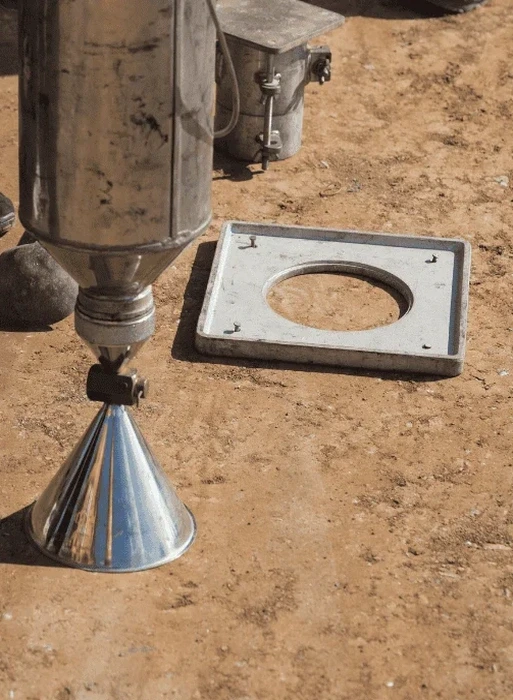
Across Leicester, the contrast between the well-draining gravels near the River Soar and the stiffer Mercia Mudstone clays to the east creates a real challenge for compaction control. Achieving spec on paper is one thing; proving it in the ground is another. That is where the sand cone method comes in. It gives a direct, physical measurement of in-place density, free from the calibration drift that can affect nuclear gauges. Our team runs these tests on residential plots in Oadby, commercial cut-and-fill sites in Thurmaston, and highway subbase along the A46 corridor. Leicester’s post-industrial land often contains pockets of ash, brick rubble, or old fill that behave unpredictably under compaction. A CPT test can map the extent of these soft zones before earthworks begin, and we often recommend it when historical maps show former brickworks or backfilled mill ponds. For every sand cone test, we log the material type, moisture condition, and any visual evidence of contamination because a density number without context is just a number.
A sand cone test gives you a number that is hard to argue with: a direct measure of mass and volume, traceable to basic physical standards.
Area-specific notes
Leicester sits about 60 m above sea level, and much of its recent development lies on river terrace deposits that can vary from loose sand to stiff clay over a few metres. The biggest risk we see is passing a density test at the surface while a looser layer sits 200 mm down, undetected. That hidden soft spot can lead to differential settlement under a lightly reinforced slab or premature rutting in a car park. Another local risk is wet weather during compaction. The East Midlands sees persistent rain from autumn through spring, and clayey fills easily become over-optimum. If the sand cone test shows high air voids or low dry density, we flag it immediately and recommend re-working or moisture conditioning before the next lift goes in. In former industrial zones around Frog Island and Belgrave, we also watch for gypsum-rich fill that can give misleading density readings if not correctly identified during the test.
Common questions
How much does a sand cone density test cost in Leicester?
A single sand cone test on a Leicester site typically costs between £90 and £130, depending on access and the number of tests booked on the same visit. Mobilisation is more efficient with four or more tests, which brings the per-test rate down.
What is the difference between a sand cone test and a nuclear gauge test?
The sand cone method provides a direct measurement of density by excavating and weighing the soil, while a nuclear gauge infers density from radiation backscatter or transmission. The sand cone is free from calibration drift and does not require a radioactive source license, but it takes longer per test and is destructive. On Leicester sites with mixed fill or variable moisture, the sand cone often gives more defensible results.
When is the sand cone method not suitable?
The method is not suitable in very coarse, granular soils with particles larger than about 37.5 mm, because the test hole becomes irregular and the sand cannot fill the voids uniformly. It is also impractical in fully saturated, flowing sands below the water table. In those cases, we may recommend alternative approaches such as a plate load test for stiffness verification or a CPT for profiling.