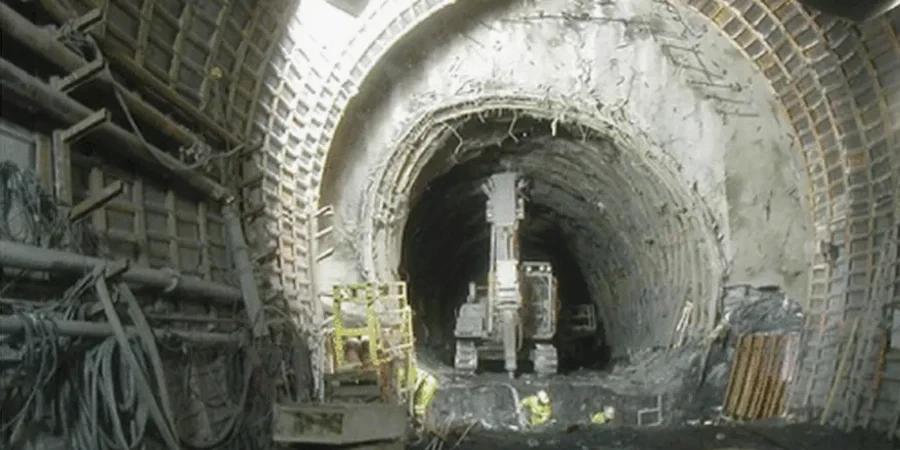
Leicester sits on a complex foundation of Mercia Mudstone overlain by thick sequences of Quaternary glacial till and alluvial deposits along the River Soar corridor, where saturated silts and soft clays can extend to depths exceeding 15 metres. Tunnelling through these materials demands a geotechnical approach that goes far beyond standard site investigation, because the transition from stiff lodgement till into normally consolidated laminated clay often occurs within a single tunnel face. When we plan an alignment under the city centre, the first priority is characterising the undrained shear strength profile and the preconsolidation pressure history of each unit, since the post-glacial clays beneath Leicester’s inner ring road are known to be lightly overconsolidated at best. Combining high-quality sampling with in-situ pore pressure measurements allows us to distinguish between materials that will stand unsupported for short periods and those that will creep almost immediately upon unloading. For deeper sections where the tunnel invert approaches the weathered mudstone interface, we often integrate the analysis with stone column ground improvement to manage basal heave and reduce long-term settlement beneath adjacent listed structures.
Understanding the preconsolidation stress history of Leicester’s glacial lake clays is often the single factor that distinguishes a successful soft ground drive from one plagued by face instability.
Process and scope
A recent tunnel drive for a utility corridor near the Grand Union Canal encountered a lens of peat and organic silt at crown level, a scenario we have learned to anticipate throughout the Soar valley. The material exhibited undrained strengths below 20 kPa and lost structure rapidly when dewatered, which required a complete revision of the face support pressure calculations mid-drive. Our methodology for these conditions starts with a detailed depositional model built from cone penetration testing and high-recovery piston sampling, followed by a suite of CIUC and CAUC triaxial tests to capture the anisotropic stiffness that governs ground movements around the excavation. We pay particular attention to the small-strain shear modulus because Leicester’s boulder clay tends to dilate during shearing, producing a nonlinear stiffness degradation curve that linear-elastic models simply cannot replicate. The output is a calibrated set of advanced constitutive parameters for finite element or finite difference analysis, typically using the Hardening Soil or Soft Soil Creep model, which we then validate against inclinometer arrays installed ahead of the face. This level of characterisation transforms the tunnel design from a conservative empirical exercise into a transparent, verifiable engineering process.
Area-specific notes
The Victorian sewer network and the post-war expansion of Leicester’s suburbs left a legacy of uncharted backfilled cellars, old culverts, and undocumented shallow workings that intersect the upper glacial deposits. When a tunnel boring machine encounters a sudden void or a pocket of water-bearing gravel within the till, the immediate risk is not just collapse but a rapid loss of face pressure that can propagate upward into a sinkhole within minutes. The mixed-face conditions typical of Leicester—where the tunnel crown is in soft clay while the invert cuts into weathered mudstone—generate differential settlement troughs that are wider and shallower than those predicted by Gaussian curve assumptions derived from London Clay experience. Our risk assessment explicitly accounts for the lateral variability observed in the Soar valley, incorporating cross-hole seismic tomography to identify buried channels and a staged dewatering protocol that prevents hydraulic uplift of the impermeable clays overlying pressurised sand lenses. We also specify real-time monitoring of surface settlement markers at 5-metre intervals along sensitive receptor zones, tied directly to trigger levels defined through a Class A prediction of ground movements.
Common questions
What methods do you use to sample Leicester’s soft alluvial clays without disturbing their structure?
We deploy thin-walled piston samplers with a 100 mm diameter through mud-rotary boreholes to recover Class 1 samples from the soft alluvium. Each tube is wax-sealed on site and transported vertically to our UKAS-accredited laboratory for CIUC and oedometer testing, ensuring the preconsolidation pressure and sensitivity values reflect true in-situ conditions.
How does the Mercia Mudstone interface affect tunnel stability here?
The transition zone between the overlying Quaternary deposits and the weathered Mercia Mudstone often contains a brecciated, water-bearing layer that acts as a preferential flow path. We characterise this contact using dynamic probing and piezometer nests to determine whether it requires advance grouting or a reduced advance rate to prevent face ravelling.
What is the typical cost range for a soft soil tunnel geotechnical analysis in Leicester?
The cost for a complete soft soil tunnel geotechnical analysis in Leicester typically ranges from £3,140 to £13,560, depending on the length of the alignment, the number of boreholes and CPT soundings required, and the complexity of the laboratory testing programme.
How do you calibrate numerical models for Leicester’s glacial till?
The reference range for this service in Leicester is £3.140 - £13.560. The final price depends on the project scope and volume.