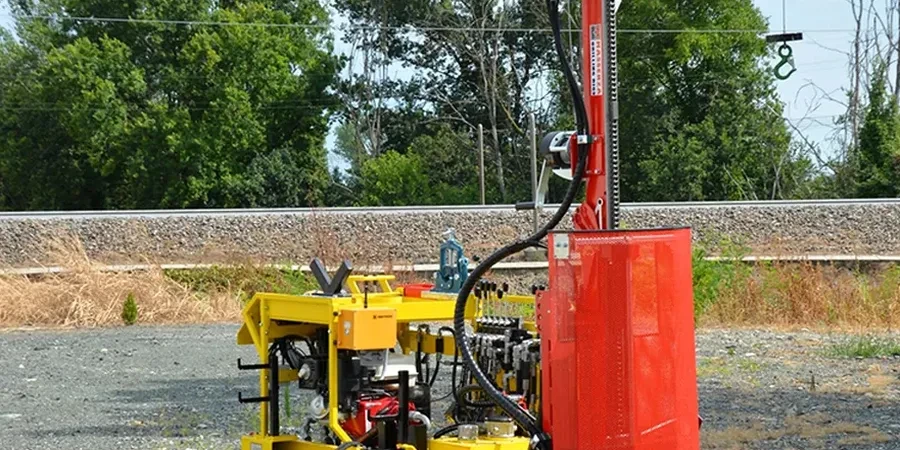
Too many foundation designs in Leicester still rely on assumed bearing pressures from a desktop study. We see it all the time. The problem hits hard when the rig arrives and finds soft alluvium along the River Soar instead of competent till. An SPT isn't just a formality for building control. It gives you the N-value profile you need to size footings correctly from day one. In this city, the transition from granular river terrace deposits to stiff clays happens over metres, not miles. A well-planned SPT campaign eliminates the guessing. We run the test to BS 5930:2015, counting blows every 75 mm of penetration with a calibrated automatic trip hammer. The data ties directly into Eurocode 7 design values. For deeper profiling where clay sensitivity matters, we often pair this with a CPT test to cross-check undrained shear strength.
SPT N-values without a moisture condition log are just numbers. In Leicester's desiccated crust, the same N=15 means very different things in August versus February.
Process and scope
Leicester's ground profile rarely repeats itself. The Mercia Mudstone weathers differently in Evington compared to the low-lying floodplain near Abbey Park. Summer desiccation cracks open the upper clay crust, while winter saturation softens the fill materials that cap much of the city centre. These seasonal swings directly affect your SPT blow counts. A test done in August can yield N-values 20% higher than one in February on the same plot. We counter this by recording moisture conditions at every sampling interval. The split-barrel sampler retrieves a disturbed sample, and our logging geologist notes consistency, colour, and any evidence of old backfill or organics. This level of logging catches lenses of peat or buried topsoil that Leicester's older ordnance maps miss. We use a 63.5 kg hammer with a 760 mm drop, verifying the energy ratio regularly to keep our results transparent and repeatable.
Area-specific notes
The ground beneath Leicester's west end and the area around the National Space Centre tells two completely different stories. Near the River Soar, you get soft alluvium and a high water table that collapses the borehole walls the moment the auger pulls out. Over in Oadby or Knighton, you might hit Mercia Mudstone at 2 metres, dense and blocky, driving refusal N-values above 50. The real risk lies in the transition zones. A site with 2.5 metres of made ground over weathered mudstone can fool a shallow investigation. The fill might be ash, brick rubble, or colliery waste from the city's industrial past. If the SPT is terminated too early, you miss the compressible layer and end up with differential settlement cracking the superstructure. We drill deep enough to confirm refusal in competent strata, not just in the first dense material we hit. This keeps the structural engineer's assumptions grounded in site reality, not regional generalisation.
Common questions
What does an SPT test in Leicester typically cost?
For a single borehole with SPTs at 1.5 metre intervals to a depth of 10 metres, budgets in the Leicester area generally range from £370 to £570. The final figure depends on access constraints, the number of boreholes, traffic management requirements, and whether the Mercia Mudstone bedrock is encountered early, affecting drilling speed.
How deep do you drill SPT boreholes in Leicester?
It varies by site and foundation type. For a standard two-storey housing plot on glacial till, 8 to 12 metres is common. Larger commercial developments on the Soar valley alluvium may require 20 metres or more to reach competent bearing strata. We always drill deep enough to satisfy the 2:1 stress distribution rule below the proposed foundation load.
How long does SPT testing take on site?
A single borehole to 10 metres with SPTs every 1.5 metres usually takes one working day in Leicester's typical soil conditions. Harder layers like the Mercia Mudstone or cobble-rich river gravels can slow penetration. We allocate a second day for deeper holes, grouting backfill, and reinstating the surface.
Can SPT data be used for pile design in Leicester?
Yes, absolutely. The N60 values are correlated directly with shaft friction and end bearing for bored piles and driven precast piles. In Leicester's mixed ground, we often use SPT profiles alongside undrained shear strength from triaxial tests to select pile founding depths. The data feeds into EC7 Design Approach 1 calculations for ultimate limit state verification.