← Home · Slopes & Walls

Slope Stability Analysis in Leicester: BS 5930 & Eurocode 7 Compliance

Together, we solve the challenges of tomorrow.

LEARN MORE →

Leicester’s topography presents a deceptive challenge. The city straddles the River Soar valley, with the eastern suburbs rising onto Jurassic clay ridges and the western edge defined by ancient pre-glacial valleys. BS 5930:2015+A1:2020 and Eurocode 7 (BS EN 1997-1:2004+A1:2013) set clear requirements for slope stability analysis here. Glacial till overlies Mercia Mudstone across much of the city, creating perched water tables that catch out unprepared developers. A desk study alone won’t cut it. Ground investigation is mandatory. We combine rotary drilling for bedrock confirmation with in-situ testing to feed limit equilibrium models. The friction angles of weathered mudstone can drop below 22° after heavy rainfall, a parameter local engineers ignore at their own risk. For projects near the River Soar’s alluvial corridor, we often complement the analysis with CPT testing to map soft clay lenses before back-analysis of existing slopes.

A Factor of Safety below 1.3 on a Mercia Mudstone cutting in Leicester demands immediate reassessment. Winter groundwater is the trigger.

Process and scope

Leicester sits at roughly 60 metres above sea level, but local slope angles in the Evington and Knighton areas exceed 15 degrees on Mercia Mudstone. That’s enough to trigger shallow failures after sustained rain. Our analysis uses Spencer’s method for non-circular slip surfaces, matching the geological reality better than simplified Bishop slices. We measure peak and residual shear strength through multi-stage direct shear tests. Pore pressure response is modelled with Ru coefficients calibrated to winter groundwater monitoring data. For the granular Head deposits overlying clay in the western corridor near Glenfield, we assess drained and undrained conditions separately. A borehole with SPT provides the stratigraphic control needed to assign realistic strength profiles to each material layer. The output is a Factor of Safety clearly benchmarked against BS EN 1997-1 Design Approach 1, Combination 1 and 2.
Slope Stability Analysis in Leicester: BS 5930 & Eurocode 7 Compliance
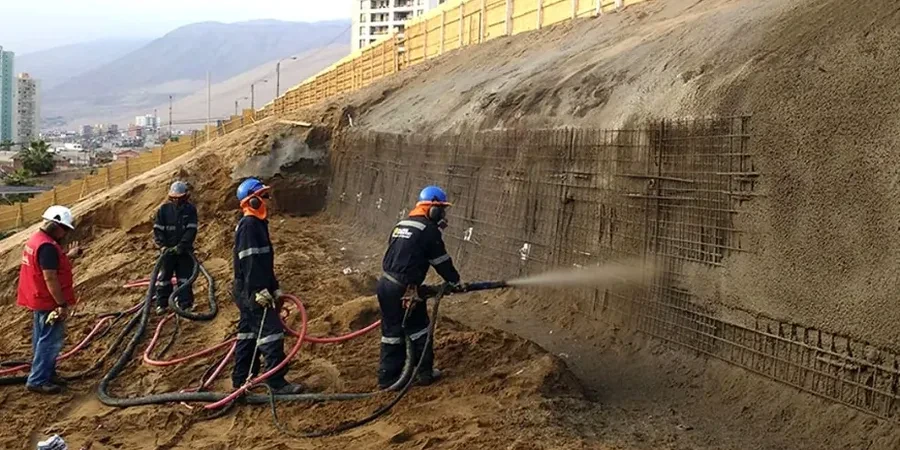
Technical reference image — Leicester

Local considerations

The most common mistake in Leicester is treating all Mercia Mudstone as Grade I or II rock. The upper 2 to 3 metres are often weathered to a stiff clay, with fissures that open during dry summers. Rain then infiltrates rapidly, destroying apparent cohesion. A slope cut at 1:2 might stand for a year, then fail overnight in November. Another error is ignoring the glacial till’s variable composition. It ranges from sandy gravel to laminated clay across a single site. Assuming a single material zone in the model produces a Factor of Safety that looks fine on paper but means nothing in the ground. We back-analyse existing failures wherever possible. The angle of a slipped scarp tells us more about in-situ strength than any lab test.

Need a geotechnical assessment?

Reply within 24h.

Email: info@geotechnical-engineering.biz

Technical parameters

ParameterTypical value
Analysis MethodLimit Equilibrium (Spencer, Morgenstern-Price)
Design StandardBS EN 1997-1:2004+A1:2013, UK National Annex
Minimum FoS - Temporary1.30 (DA1/C2)
Minimum FoS - Permanent1.40 (DA1/C2)
Shear StrengthPeak and residual (multi-stage direct shear)
Pore PressureRu coefficient calibrated to site monitoring
Seismic Coefficientkh = 0.05 (typical for Leicester, BS EN 1998-1)

Other technical services

01

Natural Slope Assessment

For greenfield development on Leicester’s eastern clay ridges. We model existing slope profiles, assess long-term degradation of strength, and design drainage measures to maintain FoS above 1.4 for permanent conditions.

02

Cutting and Embankment Verification

Transport infrastructure and residential earthworks. We verify temporary batter stability during construction and permanent slope performance, including the effect of surcharge from adjacent foundations.

Regulatory framework

BS 5930:2015+A1:2020 - Code of practice for ground investigations, BS EN 1997-1:2004+A1:2013 - Eurocode 7: Geotechnical design, BS EN 1998-1:2004+A1:2013 - Eurocode 8: Seismic actions, CIRIA C718 - Guidance on embedded retaining wall design

Common questions

What shear strength parameters do you use for Mercia Mudstone in Leicester?

We test each site rather than relying on published values. Typically, weathered Mercia Mudstone in Leicester shows peak effective cohesion (c') of 5-15 kPa and a friction angle (φ') of 22-28°, but these drop significantly for residual strength. Multi-stage direct shear tests on undisturbed samples provide the design line.

How much does a slope stability analysis cost for a site in Leicester?

The fee ranges from £1,070 to £2,840 depending on the slope height, complexity of the geological model, and whether you need a simple circular analysis or a more detailed non-circular slip surface assessment with groundwater modelling.

Do you factor in tree influence on slope stability?

Yes. Leicester has many mature deciduous trees on clay slopes, particularly oak and ash. We account for seasonal soil moisture deficit caused by root uptake, which can add 5-10 kPa to the effective cohesion in summer but disappears entirely in winter, creating a critical stability window.

What is the turnaround time for a slope stability report?

A standard analysis for a single slope profile, with lab testing already completed, takes 7-10 working days. If site investigation and lab testing are part of the scope, the full process typically runs 4-5 weeks from mobilisation to final report.
Location and service area

We serve projects in Leicester and surrounding areas.

View larger map