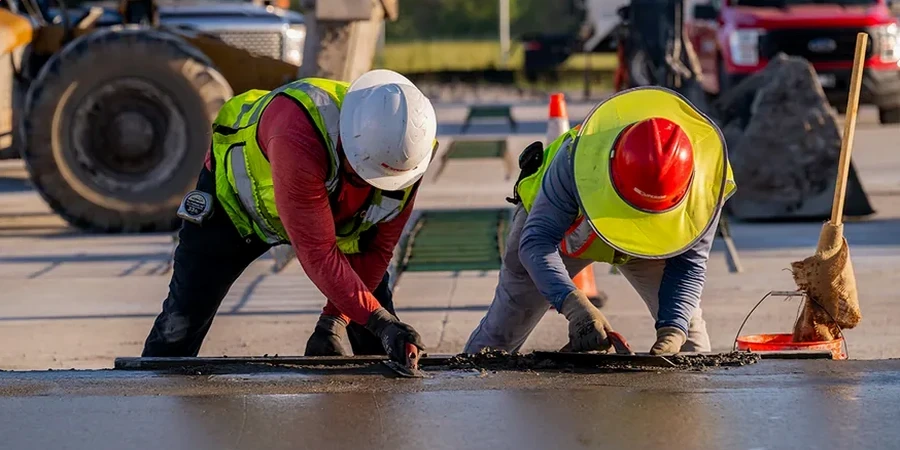
Leicester's road network has evolved from Roman tracks to the modern A46 and M1 corridors, but the underlying geology hasn't changed. The Mercia Mudstone Group dominates the city centre, while river terrace gravels follow the Soar Valley, and glacial till blankets the eastern suburbs. These transitions from stiff clay to granular deposits occur over short distances—a challenge for any concrete pavement. We've seen joints crack and slabs pump fines within two winters on the A563 Outer Ring when the subgrade wasn't properly assessed. Our team tackles this by combining site investigation with the CPT test to profile soft alluvium along the old floodplain, and the plate load test to verify the modulus of compacted granular capping before the concrete goes down.
A concrete slab is only as durable as the 300mm directly beneath it—get the subgrade wrong and the whole rigid pavement fails, no matter how much steel you put in.
Common questions
What's the typical design life for a rigid pavement in Leicester's climate?
We design to a 40-year service life for principal roads and 30 years for industrial yards, following DMRB CD 239. The key variables are traffic loading—expressed in million standard axles (msa)—and the subgrade stiffness. On the Mercia Mudstone, with proper drainage and a cement-stabilised capping, achieving 40 years is standard. We model the cumulative fatigue damage from Leicester's winter freeze-thaw cycles, typically 45-50 cycles per year, to confirm the slab won't degrade prematurely.
How much does rigid pavement design cost for a project in Leicester?
For a comprehensive design package covering ground investigation, laboratory testing, and structural pavement design, budgets typically range from £1,570 to £4,760 depending on the site area, traffic class, and whether mining risk assessments are required. A small industrial yard might fall at the lower end, while a major access road with complex joint detailing and Coal Authority checks would be at the upper end.
Do I need a mining report for a pavement project in Leicester?
If your site is east of the River Soar, particularly around Evington or Thurnby Lodge, it's likely within the concealed coalfield. The Coal Authority's development risk report is essential. Unrecorded shallow workings from the 19th century can collapse and create voids that a rigid slab can't bridge without reinforcement. We integrate this data into the subgrade risk register and design accordingly.
What's the difference between jointed and continuously reinforced concrete pavement?
Jointed unreinforced concrete (URC) uses sawn joints every 4-5 metres with dowel bars to transfer load between slabs. It's the most common choice for Leicester's industrial estates. Continuously reinforced concrete pavement (CRCP) eliminates transverse joints entirely, using heavy longitudinal reinforcement to control cracking. CRCP costs more initially but reduces maintenance on high-traffic routes. We specify based on traffic loading and the client's tolerance for future joint resealing.
How do you handle soft ground on the Soar floodplain?
The alluvial deposits along the River Soar can extend to 5 metres depth with very low bearing capacity. We specify a geogrid-reinforced granular platform over the soft layer, followed by cement-stabilised capping. If the CBR is below 1.5%, we may recommend preloading or a thicker concrete slab with enhanced reinforcement. Plate load testing on the finished formation confirms the design modulus before concrete placement.